When Your Word Is Your Bond: Integrity as an Act of Leadership
By M. E. Avila
Integrity is often discussed as a personal characteristic. We admire people who tell the truth, keep their promises, and do the right thing when no one is watching. Yet leadership demands something deeper. Integrity is not simply about honesty. It is about alignment. It is the ongoing commitment to ensure that what we believe, what we say, and what we do remain consistent over time.
There was a time when a person's word carried the weight of a signed contract. A handshake represented commitment. A promise reflected character. While today's organizations are built upon policies, procedures, contracts, and strategic plans, none of those documents can substitute for trust. Trust is built when leaders consistently do what they say they will do. It is lost when words become disconnected from actions.
My dissertation explored the concept of conocimiento, a reflective process rooted in Chicana feminist thought that asks individuals to examine who they are, what they believe, and how those beliefs influence their actions. Although my research focused on community health workers, the lesson extends far beyond healthcare. Reflection is not an academic exercise. It is an ethical responsibility. Leaders cannot expect accountability from others if they have never learned to hold themselves accountable.
This kind of self-examination reveals an uncomfortable truth. Most leadership failures do not begin with bad intentions. They begin with small compromises. A promise is postponed. A difficult conversation is avoided. Standards are enforced inconsistently. Decisions become more about convenience than principle. Individually, these moments seem insignificant. Collectively, they shape organizational culture.
People notice.
Employees rarely expect perfection from those they follow. They understand that leaders make mistakes. What they expect is consistency. They expect honesty when circumstances change. They expect transparency when decisions are difficult. Most importantly, they expect leaders to own the consequences of their choices rather than shifting responsibility elsewhere.
Leadership is ultimately a covenant with other people. The title may provide authority, but integrity earns followership.
Every decision made by a leader creates ripple effects far beyond a conference room. A missed commitment can delay a project, weaken morale, or erode confidence across an entire team. An unkept promise may seem minor to the person who made it, but it can fundamentally change how others experience psychological safety, fairness, and trust. When leaders fail to keep their word, they are not merely disappointing individuals. They are changing the culture.
This is why integrity must be viewed as an operational practice rather than a personality trait.
Organizations spend considerable time developing strategic plans, performance measures, quality improvement initiatives, and standard operating procedures. Yet every one of these systems depends upon one simple assumption: people will do what they said they would do. Without integrity, accountability systems become performative. Meetings become conversations without action. Policies become documents without meaning. Vision statements become marketing rather than commitments.
The strongest organizations are not necessarily those with the most talented employees. They are often those where people trust one another enough to make commitments and know they will be honored.
Conocimiento reminds us that integrity begins long before anyone else is watching. It begins with asking difficult questions of ourselves.
Did I communicate honestly?
Did I follow through?
Did I admit when I was wrong?
Did my actions reflect the values I expect from others?
These questions require humility because they force leaders to confront the distance between intention and behavior. Reflection is not about guilt. It is about alignment. Every act of honest self-examination creates an opportunity to close that gap.
Integrity also requires courage.
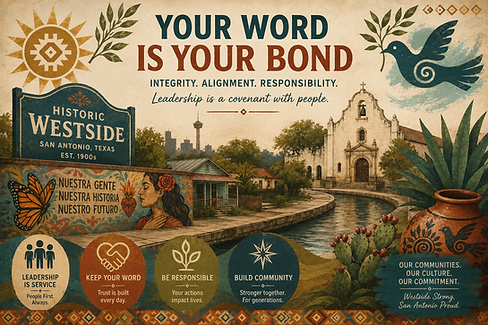
These ideas are not abstract concepts for many of us on San Antonio's Historic Westside. They have long been woven into the fabric of our community. Generations were raised believing that a person's name mattered, that respect was earned through action, and that your word carried weight. Families, neighbors, churches, and small businesses depended on relationships built over time, where trust often meant more than a written agreement. This legacy reflects values deeply rooted in Mexican and Indigenous traditions, where leadership has always been understood as service to the collective rather than personal status. In many ways, conocimiento simply gives language to what our communities have practiced for generations: leadership begins with knowing yourself, honoring your commitments, and recognizing that your actions affect not only your own reputation but the well-being of everyone connected to you. As San Antonio continues to grow and change, these cultural foundations remain among the city's greatest leadership assets, reminding us that integrity is not simply an individual virtue. Integrity is a responsibility to our families, our neighborhoods, and the generations that follow.
Keeping your word is easy when circumstances remain favorable. The true measure of character appears when honoring a commitment becomes inconvenient, unpopular, or personally costly. Those are the moments people remember. Those are the moments that define leadership.
Perhaps this is why integrity cannot be delegated. Policies can establish expectations. Human resources can investigate misconduct. Audits can identify deficiencies. None of these mechanisms create integrity. They simply reveal whether it already exists.
Culture is built through ordinary decisions repeated every day.
A leader who keeps small promises is more likely to be trusted during large crises. A supervisor who treats people fairly during routine operations is more likely to receive grace when difficult decisions become necessary. Trust accumulates over time through consistency.
At its heart, leadership is stewardship. Every leader is temporarily entrusted with people, resources, and influence that ultimately belong to something larger than themselves. Titles come and go. Organizational charts change. Careers evolve. Character remains.
When our word becomes our bond, we communicate something far more powerful than competence. We communicate reliability. We tell people they can depend on us not because we are perfect, but because our values are not situational.
Integrity is not demonstrated by what we promise. It is demonstrated by what we consistently deliver.
Long after people forget our presentations, strategic plans, or accomplishments, they remember one simple question:
Could they trust our word?


Comments