What a Storm Reveals
By M.E. Avila
On August 28, 2026, a severe storm moved through San Antonio, bringing destructive winds, heavy rain, flooding, downed trees and power lines, and widespread power outages. More than 100,000 CPS Energy customers lost electricity at the height of the event. Among the hardest hit areas was ZIP code 78207 on San Antonio's Westside, where more than 15,000 customers were reportedly affected. In the hours and days that followed, families needed electricity, food, water, cooling, transportation, information, debris assistance, and other basic resources.
For some households, the storm was disruptive. For others, it became an immediate economic and health crisis.
Losing several hundred dollars of refrigerated food means something different when there is money available to replace it. Leaving a home without electricity is easier when a family has reliable transportation, relatives with space, or enough money for a hotel. Missing work is different for someone with paid leave than for someone whose paycheck depends on every hour worked. Even charging a phone becomes critical when that phone is the connection to family, employment, emergency information, benefits, transportation, and assistance.
The storm did not create these differences. It exposed them.
To understand why an emergency can affect one neighborhood differently from another, we have to understand what existed before the emergency. In 78207, that requires looking much further back than August 2026.
San Antonio's Westside has been home to generations of Mexican and Mexican American families and has a history shaped by culture, labor, family, faith, entrepreneurship, political activism, and strong community relationships. It also has a documented history of poverty, inadequate housing and sanitation, infectious disease, flooding, segregation, discriminatory housing practices, and struggles for equitable public investment.
One of the earliest examples came through flooding. On September 9, 1921, catastrophic flooding devastated San Antonio. Although downtown received considerable attention, predominantly Mexican neighborhoods on the Westside experienced devastating losses as waterways such as Alazán Creek overflowed. Families living near flood-prone areas in poorly constructed housing faced risks compounded by inadequate drainage, infrastructure, and economic resources. Flood control improvements eventually transformed portions of San Antonio, but Westside communities continued dealing with flooding and inadequate infrastructure for decades.
At roughly the same time, another crisis was revealing the relationship between geography and health. During the early twentieth century, many Mexican and Mexican American families on the Westside lived in corrales, clusters of small and often overcrowded dwellings. Some lacked indoor plumbing, electricity, adequate ventilation, paved streets, and connections to municipal sewer systems. Overcrowding, inadequate sanitation, poor nutrition, and limited access to healthcare created conditions in which infectious disease could spread and families already living with few resources could become even more vulnerable.
Tuberculosis became one of the starkest examples. In 1926, the tuberculosis death rate among Hispanics in San Antonio reached approximately 343 deaths per 100,000 people, dramatically higher than the rate among Anglo residents. Between 1939 and 1941, San Antonio had the highest tuberculosis death rate among the 92 largest cities studied in the United States. Within the city, however, the burden was profoundly unequal. The tuberculosis death rate among the Hispanic population was approximately 302 per 100,000, compared with approximately 52 per 100,000 among white residents.
By 1942, a mass X-ray survey involving more than 20,000 San Antonio residents provided further evidence of the disparity. Approximately one in every 20 Mexican and Mexican American residents examined was found to have tuberculosis, roughly five times the rate within the general United States population. Studies of the period connected these health outcomes with inadequate housing and sanitation, overcrowding, nutritional deficiencies, and low earnings.
Tuberculosis was caused by bacteria, but bacteria alone could not explain why the burden of disease was so geographically and racially unequal. Housing, nutrition, employment, income, sanitation, and infrastructure all influenced health.
During this same period, housing and lending systems were reinforcing the geography of inequality. In the 1930s, federal residential security maps graded neighborhoods according to perceived investment risk. These maps reflected racial and ethnic prejudices embedded in housing and lending systems of the era. Mexican and Mexican American neighborhoods could be characterized as undesirable or risky investments, while areas viewed more favorably for mortgage lending were generally associated with white residents and newer development. Neighborhoods receiving the lowest designation were outlined in red, contributing to what became known as redlining.
A red line on a map did not act alone. Discriminatory lending, segregation, restrictive housing practices, low wages, unequal access to credit, and uneven public and private investment operated together. For Mexican American families, these conditions constrained where people could live and limited opportunities to build wealth through property ownership while their neighborhoods also struggled with overcrowding, flooding, poor sanitation, and inadequate infrastructure.
But Westside residents were never simply passive observers of these conditions.
When systems did not adequately respond, people organized.
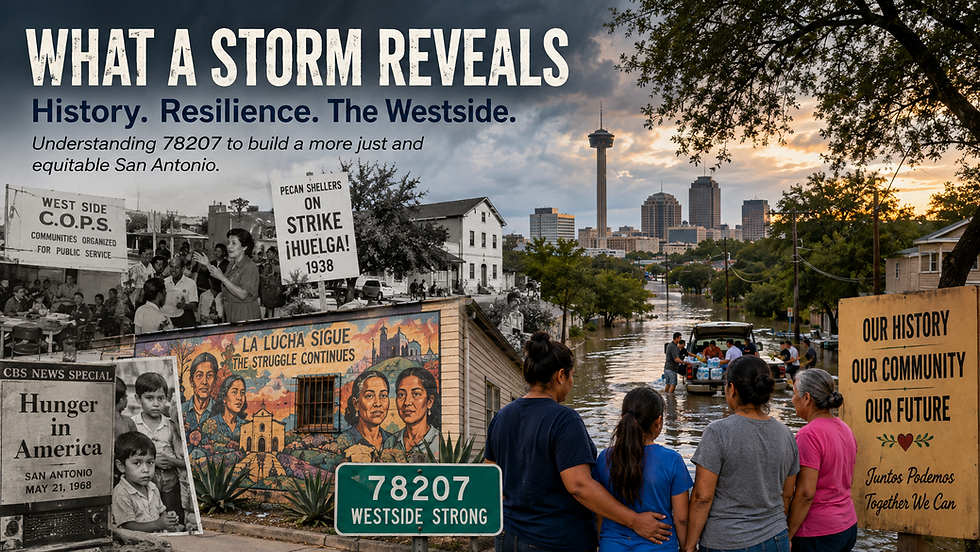
During the Great Depression, Mexican American workers in San Antonio's pecan shelling industry became part of one of the most important labor struggles in the city's history. In 1938, thousands of pecan shellers, many of them Mexican American women earning extremely low wages while working under unhealthy conditions, walked off the job. Emma Tenayuca became one of the most visible leaders associated with the strike. Workers challenged an economic structure that depended upon poorly compensated Mexican American labor while many of those same families lived in some of the city's most impoverished neighborhoods.
Long before workforce development, economic equity, or women's leadership became common institutional language, Westside women were organizing around the economic conditions affecting their families. Their leadership emerged from workplaces, homes, churches, neighborhoods, and the necessity of making institutions pay attention.
The decades that followed produced new forms of organizing. Mexican American residents challenged unequal schools, employment discrimination, poverty, housing conditions, and political exclusion. Mutual aid networks, churches, neighborhood organizations, educators, labor organizers, and community leaders created spaces where people could collectively address problems that individuals had little power to change alone.
By the 1960s and 1970s, San Antonio's Westside had become an important center of the Mexican American civil rights movement. Young activists challenged political structures that had long governed a majority Mexican American city while leaving Mexican American neighborhoods with limited influence over the decisions affecting them.
Rosie Castro emerged from this period of organizing. A Westside activist involved in the Mexican American civil rights movement and La Raza Unida Party, Castro worked on issues involving political representation and conditions facing Mexican American communities. Her activism represented a generation unwilling to accept that decisions about their neighborhoods should continually be made without them. The struggle was not simply for a seat at an existing table. It was about changing who possessed political power and whose experiences mattered when public decisions were made.
The urgency surrounding poverty on the Westside became nationally visible in 1968.
That year, San Antonio was presenting itself internationally through HemisFair '68. The exposition represented modernization, economic development, culture, and an optimistic vision of the city's future. On May 21 of that same year, CBS News aired Hunger in America, showing Americans another San Antonio.
The documentary prominently featured San Antonio's predominantly Mexican American Westside. Correspondent Charles Kuralt reported that approximately 100,000 Mexican Americans in San Antonio were hungry all the time. Cameras documented families living in severe poverty and children experiencing the physical consequences of inadequate nutrition. One of the documentary's most disturbing stories involved a severely malnourished infant being treated at Robert B. Green Hospital who later died. In another scene, a Westside teenager explained that he had eaten beans for breakfast and nothing for lunch because his family could not afford the 35 cents required for the school meal.
The contrast was striking. San Antonio was presenting an international vision of progress while national television documented hungry Mexican American children only a short distance away.
Yet the Westside was increasingly refusing to allow others to define its circumstances for it.
That tradition became especially powerful during the 1970s through Communities Organized for Public Service, better known as COPS. Founded in 1974, COPS brought together predominantly Mexican American residents through Catholic parishes and neighborhood institutions on San Antonio's West and South sides. Women became a major force within the organization. Residents learned how municipal budgets worked, documented infrastructure deficiencies neighborhood by neighborhood, organized meetings, confronted public officials, and demanded investment in streets, drainage, flood control, parks, libraries, and other basic services.
COPS demonstrated that residents historically excluded from political decision-making could learn the mechanics of government and use that knowledge to hold institutions accountable. Drainage was not abstract when your street flooded. A municipal budget was not simply a spreadsheet when its allocation determined whether one neighborhood received improvements while another continued waiting. Women who might have been publicly viewed primarily as mothers, homemakers, parishioners, or neighborhood residents became negotiators, organizers, speakers, strategists, and civic leaders.
That movement toward representation also began changing who sat inside government.
María Antonietta Berriozábal became an important part of that history. Raised on San Antonio's Westside, she became the first Mexican American woman elected to the San Antonio City Council in 1981. Her election represented more than an individual political achievement. A Mexican American woman from the Westside was now participating directly in decisions involving municipal resources, neighborhoods, budgets, infrastructure, and the future of the city.
The leadership represented by Emma Tenayuca, Rosie Castro, María Antonietta Berriozábal, the women of COPS, and countless people whose names never appeared in newspapers or history books belongs to a larger tradition of translating community experience into organized action.
This history prevents us from telling the story of 78207 only through deprivation. The Westside is not simply a neighborhood where tuberculosis occurred, where children experienced hunger, where flooding happened, or where discriminatory housing practices restricted investment. It is also a community where people repeatedly organized against those conditions.
The Westside of 2026 is not the Westside of 1926, 1938, 1968, 1974, or 1981. Considerable progress has occurred, much of it because generations of residents fought for it. Yet significant economic and health disparities remain. ZIP code 78207 continues to be overwhelmingly Hispanic or Latino, with household income substantially below that of San Antonio overall and significant numbers of residents experiencing poverty or lacking health insurance.
Then, in August 2026, another emergency arrived.
A storm lasting hours landed on top of conditions shaped over generations.
Disaster vulnerability is not determined only by wind speed, rainfall totals, or the number of hours without electricity. It is also determined by what resources people possess before an emergency begins. A family with savings can absorb the loss of groceries. Another may have purchased those groceries with the last available money before the next paycheck or benefit deposit. A household with reliable transportation can leave the neighborhood looking for ice, food, electricity, or somewhere cooler. A household without transportation has fewer choices. Someone with paid leave may have time to deal with damage. An hourly employee may lose income precisely when household expenses are increasing.
The storm may be the same. The ability to recover is not.
Formal systems responded after the August storm. City departments, CPS Energy, first responders, nonprofit organizations, resilience hubs, faith communities, and other partners mobilized resources and worked to address outages and community needs. That response matters and should be acknowledged. Yet the magnitude and immediacy of the need meant formal systems could not be everywhere at once.
Once again, community networks activated.
Neighbors checked on neighbors. People circulated information about shelter, cooling locations, food, electricity, charging, damage reporting, and other assistance. Volunteers offered transportation and supplies. Faith communities and organizations activated their networks. Individuals reached out to people they knew and asked what was needed. Community members began connecting resources with residents because immediate needs did not always have the luxury of waiting.
Viewed only through the events of August, this response might appear spontaneous. Viewed through the history of the Westside, it looks familiar.
From the pecan shellers who organized around wages and working conditions in 1938, to activists such as Rosie Castro who challenged political exclusion, to COPS members who demanded infrastructure investment, to María Antonietta Berriozábal carrying a Westside perspective into City Hall, the circumstances have changed, but the practice of organizing around community need has not.
The August storm offered another example of that tradition. It also raised an important question about what happens after communities mobilize.
The people who know which older adult lives alone, which family lacks transportation, who depends on electrically powered medical equipment, or which household has not been heard from possess knowledge that may not immediately exist within an institutional system. Organizing food deliveries requires logistics. Circulating accurate information requires communication. Connecting families with assistance requires systems navigation. Coordinating volunteers requires leadership and project management.
We often describe these activities simply as helping. In professional environments, many of the same abilities have titles, job descriptions, and salaries.
Women have carried much of this connective labor across the history described here. Their leadership can be seen in labor organizing, neighborhood advocacy, political movements, churches, families, community organizations, and the informal networks that activate during emergencies. Recognizing that history should not mean expecting women or historically under-resourced communities to continue filling gaps through unpaid labor. It should push us to consider how community leadership is valued and where opportunities for investment already exist.
Training, credentials, mentorship, employment pathways, entrepreneurship, and access to capital can build upon capabilities people are already demonstrating. A woman organizing a neighborhood response may possess skills relevant to emergency management, public health, nonprofit operations, logistics, communications, or project management. Someone who routinely connects families with resources may already be practicing many of the skills associated with community-facing professions.
Economic opportunity also changes what recovery looks like.
Savings, stable employment, transportation, insurance, housing stability, professional
networks, and accumulated assets give households more choices when something goes wrong. This is where the history of redlining, unequal investment, health disparities, and disaster vulnerability intersect. They are not identical issues, but they influence the resources families can draw upon when an emergency occurs.
Understanding those connections requires more than documenting what happened after a storm. Numbers can tell us how many households lost electricity or how many residents live below a particular income threshold. Community experience helps explain what those numbers mean, where assistance reached people, where it did not, and which relationships became essential when formal systems were stretched.
The history of 78207 reminds us that emergencies do not arrive on a blank landscape.
The 1921 flood encountered neighborhoods already struggling with inadequate infrastructure. Tuberculosis flourished amid overcrowding, poor sanitation, poverty, and inadequate nutrition. Redlining and discriminatory housing practices restricted access to investment and wealth-building opportunities. Hunger in America exposed severe poverty in 1968 while San Antonio presented a very different image of itself through HemisFair. Across those periods, Westside residents responded by organizing workplaces, churches, neighborhoods, political movements, and eventually the institutions making decisions about their communities.
The August 2026 storm belongs to a different moment, but it raises a familiar question: who has the resources to withstand disruption, and whose knowledge becomes essential when systems are stretched?
This is why resilience alone is not enough.
There is a danger in praising communities for repeatedly overcoming conditions that greater investment could help prevent or mitigate. The strength of the Westside should be recognized, but it should not become an excuse for expecting residents to continually compensate for gaps around them.
Recovery should therefore be measured by more than restored electricity, cleared debris, or a return to normal. It should also ask whether households are better positioned for the next disruption, whether community networks are supported before they are needed, and whether the people who continually emerge as organizers and connectors have opportunities to translate that leadership into greater economic stability and influence.
The Westside has spent generations demonstrating its ability to organize, advocate, and care for its own.
The next chapter should not require another crisis to recognize the value of that leadership.


Comments