Beyond the SOP: What Emergency Operations Planning Can Teach Every Organization
- 5 days ago
- 5 min read
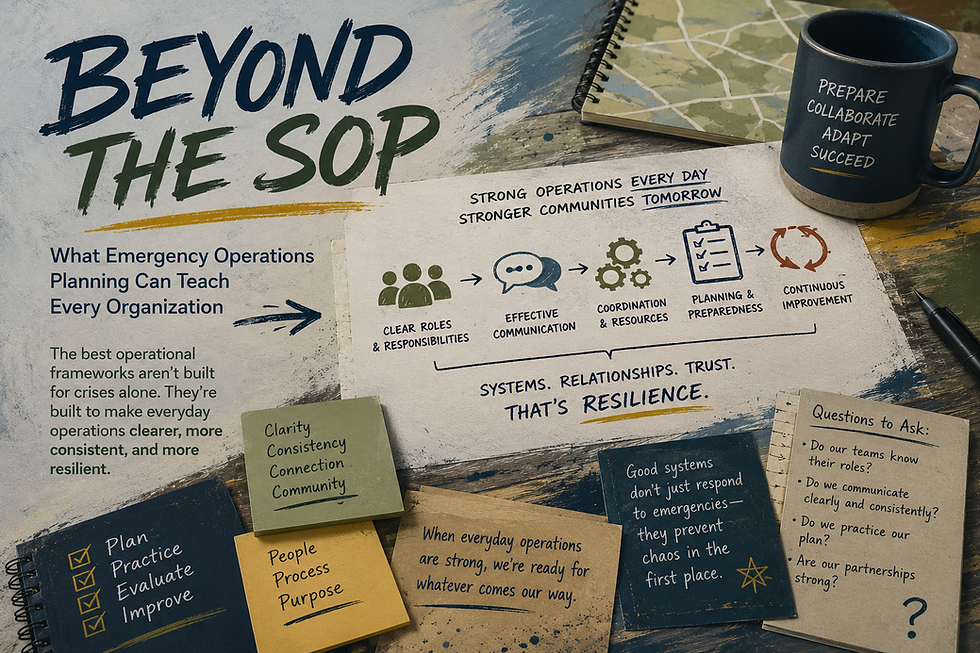
The best operational frameworks aren't built for crises alone. They're built to make everyday operations clearer, more consistent, and more resilient.
By M. E. Avila
When most people hear the words Emergency Operations Plan (EOP), they immediately think of hurricanes, floods, pandemics, or other large-scale emergencies. They picture emergency managers coordinating resources from an Emergency Operations Center, making rapid decisions under pressure, and guiding communities through uncertainty.
While Emergency Operations Plans were designed for disasters, one of their greatest contributions extends far beyond emergency response. They offer a framework for how organizations should operate every day.
Whether in public health, education, healthcare, nonprofit management, local government, or the private sector, every organization depends on people making decisions, communicating effectively, coordinating resources, and adapting to unexpected challenges. Emergencies simply magnify the strengths and weaknesses that already exist within an organization's daily operations.
If communication is inconsistent during routine work, it will likely become even more problematic during a crisis. If roles and responsibilities are unclear on an ordinary Tuesday morning, they will almost certainly remain unclear when the pressure is higher.
That is why emergency management has so much to teach organizations that may never respond to a disaster. One of the greatest misconceptions about Standard Operating Procedures (SOPs) is that they exist simply to document tasks. Organizations often spend significant time describing what employees should do while giving far less attention to how work should be coordinated. A well-written procedure should do more than list steps. It should establish an operational framework that supports consistency, accountability, communication, and decision-making across an entire program.
Emergency Operations Plans have embraced this philosophy for decades. An effective EOP clearly defines roles and responsibilities before they are needed. It establishes lines of authority so decision-making remains clear under changing conditions. It outlines communication procedures to ensure critical information reaches the right people at the right time. It identifies how resources will be coordinated across teams and organizations while clarifying the responsibilities of partner agencies that must work together to achieve a common objective.
These same principles can strengthen nearly every program, regardless of industry. Public health provides an excellent example. Whether supporting maternal and child health, disease prevention, behavioral health, violence prevention, environmental health, emergency preparedness, or community engagement, programs rarely operate in isolation.
Success depends upon multiple teams working together across disciplines, organizations, and sectors. Hospitals, schools, nonprofits, community-based organizations, healthcare systems, emergency responders, faith communities, and local governments frequently share responsibility for improving community outcomes.
When operational expectations are unclear, even highly skilled professionals can experience confusion. Responsibilities become duplicated or overlooked. Communication becomes inconsistent.
Employees begin interpreting procedures differently. Valuable time is spent clarifying expectations instead of serving communities. These are often viewed as personnel issues. More often, they are systems issues.
Emergency management approaches operations from a different perspective. Rather than assuming people will simply figure things out, it assumes organizations have a responsibility to build systems that reduce uncertainty before uncertainty ever arrives. The framework is designed so that individuals are supported by clearly defined processes instead of relying on institutional memory, individual personalities, or informal practices that disappear when staff leave.
This shift in thinking is one of the most valuable lessons emergency management offers organizational leadership. Preparedness is not about predicting every possible situation. It is about creating systems that allow organizations to respond effectively to situations they cannot predict.
The same principle should guide the development of Standard Operating Procedures. Instead of attempting to write instructions for every possible circumstance, organizations can establish clear decision-making frameworks that identify responsibilities, communication pathways, escalation processes, documentation expectations, and resource coordination. Employees are then equipped to exercise professional judgment within a structure that promotes consistency rather than confusion.
Emergency management also recognizes that no plan is ever finished. Emergency Operations Plans are not written once and placed on a shelf. They are exercised, evaluated, revised, and strengthened through continuous improvement. Exercises reveal gaps before real incidents occur. After-action reviews capture lessons learned. Policies evolve as organizations grow and new challenges emerge.
Every Standard Operating Procedure deserves the same level of attention. Rather than viewing SOPs as static documents created to satisfy accreditation requirements or organizational policy, they should become living operational tools that evolve alongside the programs they support. Leaders should regularly ask whether employees understand the procedures, whether they accurately reflect current practice, whether communication pathways remain effective, and whether responsibilities are still clearly defined. When the answer is no, the document should improve, not because compliance requires it, but because operations depend on it.
Perhaps one of the most overlooked lessons from emergency management is that successful operations depend just as much on relationships as they do on procedures. Emergency Operations Plans assume that no organization responds alone. Hospitals coordinate with emergency medical services. Public health departments collaborate with emergency management agencies. Schools partner with law enforcement. Community organizations support shelters and recovery efforts. Private industry contributes essential resources. None of these partnerships can be created in the middle of an emergency. They must exist beforehand.
The same is true during everyday operations. Strong programs are built on trusted relationships, shared understanding, and clear expectations. Communication becomes easier because people already know one another. Decisions happen more quickly because authority has been established in advance. Collaboration becomes more effective because partners understand both their own roles and the roles of others.
Preparedness, in many ways, is simply good organizational design.
It is the intentional creation of systems that help people succeed under both routine and extraordinary circumstances. It recognizes that clarity reduces confusion, communication builds trust, and clearly defined processes create consistency across teams regardless of staffing changes, competing priorities, or unexpected challenges.
Emergency Operations Plans are not valuable because they prepare organizations for disasters.
They are valuable because they demonstrate what resilient organizations look like. As organizations continue searching for ways to improve efficiency, accountability, employee engagement, and service delivery, they may not need entirely new management philosophies. Many of the answers already exist within the principles of emergency management. By adopting its emphasis on clear roles, coordinated communication, operational flexibility, continuous improvement, and collaborative partnerships, organizations can create Standard Operating Procedures that do more than describe work.
They can create operational frameworks that strengthen the people doing the work. Perhaps the next time an organization sits down to write or revise a Standard Operating Procedure, the most important question will not be whether every task has been documented.
The better question may be this:
If this procedure had to be implemented tomorrow under less-than-ideal circumstances, would every person involved understand their role, know how to communicate, know who makes decisions, and have the flexibility to adapt while still achieving the mission?
If the answer is yes, then the organization has done more than write an SOP. It has begun building resilience into its everyday operations.


Comments