Beyond the Plan: Building Resilient Communities Before the Disaster Strikes
- Jul 10
- 5 min read

By M. E. Avila
When most people hear the words emergency management, they picture hurricanes, floods, wildfires, or Emergency Operations Centers buzzing with activity. They think about response. I think about everything that happens before that moment. After working across public health, community engagement, violence prevention, workforce development, and emergency preparedness, I have come to believe that the strongest emergency plans are not built during a disaster. They are built through relationships long before disaster ever strikes. Preparedness does not begin when an Emergency Operations Center activates. It begins with trust.
Throughout my career, one lesson has remained constant: communities already possess the knowledge, strengths, and resilience needed to respond to adversity. Our responsibility is not to arrive with every answer but to recognize, support, and strengthen what already exists. Whether I am working alongside emergency managers,
Community Health Workers, nonprofit organizations, healthcare professionals, educators, faith leaders, businesses, or neighborhood advocates, I continue to see the same pattern. The organizations and communities that recover most effectively are rarely the ones with the largest budgets or the most sophisticated plans. They are the ones that invested in relationships before the crisis ever began.
My doctoral research further reinforced this belief. I studied Community Health Workers through the lens of nepantla, a concept describing the space between different worlds, identities, and systems. What I discovered reflected what I had experienced throughout my career. Community Health Workers do far more than connect people to services. They connect people to hope. They translate more than language; they translate systems, expectations, and opportunities. They navigate barriers that are often invisible in emergency plans, including culture, trust, transportation, fear, immigration concerns, and lived experience. Their work challenged me to think differently about expertise.
Too often, expertise is measured only by degrees, certifications, or job titles. Those credentials certainly matter, but they are not the only form of expertise that strengthens a community. Expertise can also come from raising a family through hardship, caring for neighbors during difficult times, understanding the history of a neighborhood, or knowing which organizations people genuinely trust. Emergency management has traditionally emphasized technical expertise, yet community expertise deserves equal recognition because it provides the context that makes technical solutions meaningful and effective.
Preparedness is often associated with emergency kits filled with water, medications, flashlights, batteries, radios, and important documents. These supplies are essential, but resilience cannot be measured solely by what is stored in a closet or emergency bag. Real preparedness is reflected in relationships. Do neighbors know one another well enough to check in during an extended power outage? Are trusted organizations already connected with vulnerable populations? Can emergency messages reach individuals who speak languages other than English or who experience disabilities? Have community members been invited into planning conversations before decisions are made, or are they only asked to participate after plans have already been finalized?
These questions reveal far more about a community's resilience than the contents of an emergency supply kit.
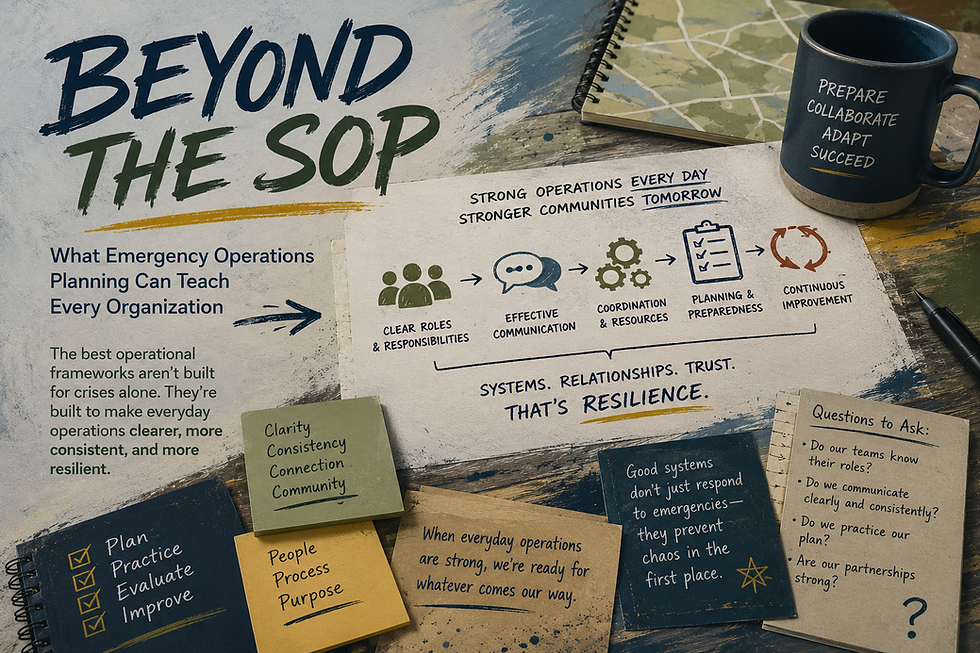
Strong preparedness also depends on collaboration. No single profession or organization can prepare an entire community alone. Emergency management provides coordination and structure. Public health focuses on prevention and population health. Healthcare systems ensure continuity of care. Educational institutions build knowledge and preparedness skills. Community-based organizations establish trust through long-standing relationships. Community Health Workers bridge systems while helping individuals navigate complex services. Law enforcement, fire departments, emergency medical services, emergency managers, businesses, and volunteers each play essential roles before, during, and after disasters. When these sectors intentionally collaborate before disasters occur, communities are far better equipped to respond, recover, and adapt. Preparedness has never belonged to one agency. It is a shared responsibility built through partnerships.
Leadership also looks different during emergencies than many people expect. One of the greatest misconceptions is that effective leaders must always have every answer. In reality, the strongest leaders remain calm when uncertainty is high. They communicate honestly, acknowledge what they know and what they do not know, listen before they speak, and adapt as new information emerges. Most importantly, they never lose sight of the people behind the data. Every statistic represents a family. Every resource request reflects a community's needs. Every recovery effort represents someone's opportunity to rebuild a home, restore stability, or begin again. Effective emergency management is ultimately about people, not simply processes.
A Five-Minute Resilience Check
Before moving on to your next meeting or project, take a few minutes to reflect on your organization's readiness. Resilience is built through consistent actions long before disaster strikes.
Leadership
☐ We review our emergency or continuity plans at least annually.
☐ Staff understand their roles and responsibilities during an emergency.
☐ We regularly conduct exercises or tabletop discussions to strengthen our preparedness.
Partnerships
☐ We know and actively engage our community partners before we need them.
☐ Community voices are included throughout planning and decision-making.
☐ We collaborate across sectors instead of working in silos.
Communication
☐ Our emergency communications are accessible, inclusive, and culturally responsive.
☐ We consider language, disability, technology, transportation, and literacy barriers when sharing information.
☐ We communicate consistently before, during, and after emergencies.
Workforce
☐ Employees receive preparedness and response training appropriate to their roles.
☐ Staff know where to access wellness and mental health resources following a crisis.
☐ We routinely use lessons learned to improve future planning.
If you could not confidently check every box, do not be discouraged. Preparedness has never been about perfection. It is a continuous process of learning, strengthening relationships, and improving together. Every investment made before a disaster increases a community's capacity to withstand challenges and recover more effectively.
One of the greatest lessons emergency management has taught me is that resilience cannot be manufactured during a disaster. It must be cultivated long before an incident occurs. Every partnership built today becomes a resource tomorrow. Every conversation with a community member strengthens trust. Every tabletop exercise builds confidence. Every after-action review creates an opportunity to improve. These investments may seem small in the moment, but together they become the foundation communities rely upon when disaster strikes.
As someone who has spent my career working at the intersection of public health, community engagement, violence prevention, workforce development, and emergency preparedness, I have learned that our greatest asset will never be a plan sitting on a shelf. Plans are essential, but they only become meaningful when they are supported by relationships, collaboration, and trust. At the end of every emergency operation, every Incident Action Plan, every situation report, and every recovery effort is a community simply trying to move forward.
If we invest in people before disaster strikes, resilience will not be something we hope for when a crisis arrives. It will be something we have already built together.

Comments